A day with Ink: from a few tools to a writer that proposes
I’m building a writing app for authors who know what their story is but get stuck putting it on the page, on a scene or a dialogue. It’s React on the front and a Fastify API behind it. These are my notes from one day of work on its agent, with Claude Code as my pair.
The app is a planning board for a novel: scenes on a timeline, characters, a plot, notes, and an AI assistant called Ink in the right column. The rule that was never up for debate: Ink writes nothing into the book on its own. Everything it makes is a proposal the user accepts.
Ink started with limited superpowers, just a few tools, and today it is capable of driving an agentic flow for writing a novel.
Morning: the model, then the question
The first thing was practical. Ink ran on a local Gemma through Ollama and took minutes per turn, so I switched it to DeepSeek through an OpenAI-compatible endpoint.
Problem: the first lesson of the day had nothing to do with AI. The API
process had been started before the .env change, tsx watch does not
reload environment files, and five stale watchers were still alive. So: kill
everything, restart, and log the provider and model at startup, so this never
costs me an hour again.
With a fast model, the question I had been postponing came up: what is Ink for? We ran a long interview, five rounds of numbered questions with a recommended answer each, and the answers reshaped the design:
- Tools are typed on the shape of a change (create scenes, split a scene,
edit scenes, write the plot, review, read a scene, label a scene). The
intention is free text, an
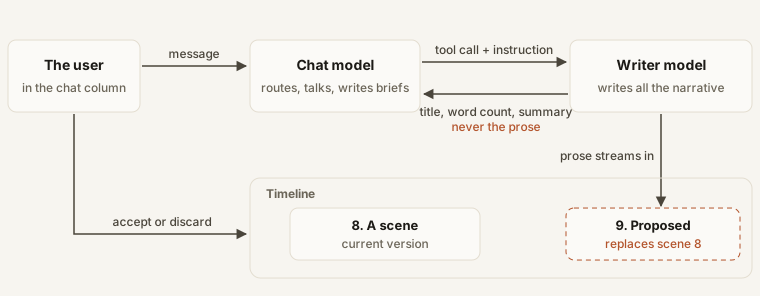
instructionthe chat writes for the writer. So there is no “translate” tool and no “shorten” tool: those are instructions. - Two model roles. The chat routes, converses, and writes briefs. The writer produces every piece of narrative: outlines, splits, prose, edits, the plot. The reviewer runs on the writer’s slot. Each one is a single system prompt with holes filled by code.
- Proposals are scenes: real rows in the timeline with a
statusofproposedand areplacespointer, instead of ghost cards in the chat. Accepting one proposal that points at a scene is an edit; accepting two is a split. They are dashed in the timeline, where the user already lives. - No limits, but visible tokens. I was about to cap scenes per turn and words per scene, and the decision was the opposite: show what each turn cost under every reply and let the user decide.
Afternoon: eight items, unattended
I went away and left a list. Here is what came back, each step verified from a shell script that drives the chat, and from the browser where the UI changed:
- A
usageevent under every reply: tokens in, tokens out, and how full the context window got, with chat and sub-agents added up. - The migration and endpoints for proposed scenes, with accept and discard for one or for all.
- The writer behind
editScenes: an empty proposal appears in the timeline first, the prose streams into it, and it is saved when done. Four are in flight at a time, so “translate every scene” is one call. - Main scenes from the plot, and splitting a scene through the writer, both
returning the same
## Titlesections the importer already reads. Plus the plot itself, from a two-line idea. - A scene opens in the centre column, with the current text next to the proposed one.
- The reviewer: the structural facts are computed in code and handed to a model whose text streams straight to the user.
- A real Stop, as a request of its own. A dropped browser tab no longer kills a write in progress: the turn finishes and the proposal is saved.
- Once the book has prose, the chat’s prompt lists an index, and a tool fetches one scene on demand.
Two decisions I made alone and flagged for review: the writer returned content only (no summary), and the reviewer’s text bypasses the chat entirely. The first one did not survive the evening.
Evening: where the prose goes
Back at the keyboard, the questions were about plumbing, which turned out to be where the tokens were going.
What does a tool return to the chat? The JSON object the tool’s function
returns, serialized into a message of role tool. That message joins the
conversation history, which is sent again on every later turn until it
falls out of the 40-message window.
Problem: the writer’s prose was in that object. So every scene Ink wrote was re-sent, in full, on every message for the next forty.
The fix was the structured output I had avoided in the afternoon, done
without structured output. The writer now closes with a
## Summary line. The streaming loop holds the marker back from the
timeline, the parser cuts it from the content on save, and the tool returns
title, word count and that one sentence. The chat never sees the prose
unless it asks for it, and the summary comes from the model that wrote the
text, instead of one reading an excerpt.
Follow-up problem: why did the chat hallucinate duplicates? After a split, the listing read “8. Title”, “9. Title (PROPOSED)”, “10. Title (PROPOSED)”. Two lookalikes side by side, and the chat told the user there were duplicates to clean up. I had patched it with a sentence in the prompt, but the better fix was structural: the listing now says, on both sides, what the relation is. A proposal names the scene it replaces; a scene names the proposals waiting to replace it, “its possible next version, not duplicates”. My reasoning: a prompt rule asks the model to remember, while I think a listing that states the relation leaves it nothing to misremember.
Final bit: a prompt change can’t be unit-tested, so the day ended with an eval. It’s a shell script that plants two replacements of a scene through the API, asks the chat where that scene stands, and fails if the reply contains “duplicate”. It passed twice. The result is not deterministic, so it runs every time the prompt or the listing changes. When there are three of these, I’ll move to promptfoo, not before. The chat, by the way, did better than pass: it noticed that accepting the two replacements would leave a causal hole two scenes later!
What is next
Retrieval. The index shows a scene’s first lines, so a user who refers to a fact rather than a scene number leaves Ink blind, and “where did I mention the blue car” needs more reads than a turn has steps. I see three layers, in order of cost:
- A token budget instead of a word threshold, so a short novel is always sent whole.
- A summary per scene in the index, which the writer now produces anyway.
- A search tool: full-text first, embeddings only if paraphrase proves necessary.
None of it is built. Tomorrow’s question is which one comes first.
Thanks for reading!